

 English
  Español
Growing interest in professional bar tools has placed the High End Cocktail Shaker Supply market, the developments in Mixology Cocktail Kit Manufacturing, and the accessibility of a Cheap Complete Bartender Kit under increasing attention. From commercial bars and hotels to training programs and home mixology setups, users look for equipment that supports consistent drink making and matches real-world workflow expectations. Understanding how these products are designed, manufactured, and evaluated allows buyers to make choices suited to long-term use.
How Cocktail Shaker Construction Influences Daily Service
A cocktail shaker appears simple, yet its performance depends heavily on structural details. In the context of High End Cocktail Shaker Supply, several design elements influence how the shaker behaves during shaking, sealing, and pouring.
Wall thickness affects temperature transfer and handling comfort. Thicker walls may offer a steadier feel in hand, while thinner walls cool more rapidly, which some bartenders prefer for citrus-forward drinks. The joining surfaces—whether cobbler-style or Boston-style—require careful shaping to reduce leakage risk. Even minor misalignments can affect seal stability during vigorous shaking.
Bars operating at high volume notice these details quickly. A shaker that opens smoothly after chilling, maintains its shape through repeated use, and balances well during motion supports efficient service. High-end production often includes tighter quality tolerances, but users still need to match shaker styles with their working preferences.
The Role of Manufacturing Standards in Mixology Kits
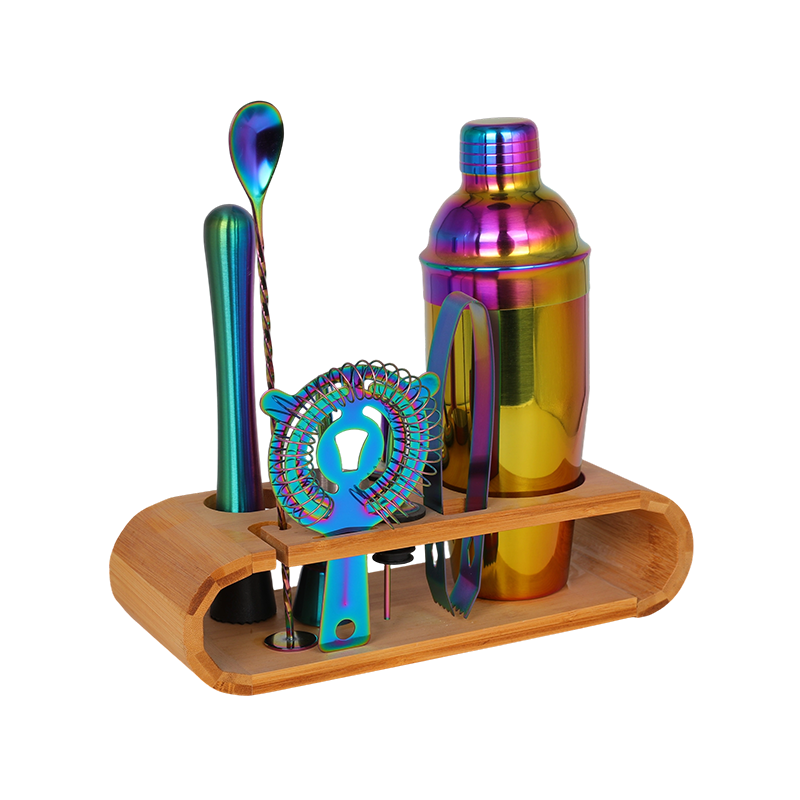
When discussing Mixology Cocktail Kit Manufacturing, the focus shifts from individual tools to the overall integrity of a complete set. Manufacturing involves more than assembling shakers, spoons, jiggers, and strainers; it requires ensuring that each component functions consistently across batches.
Several key considerations shape the manufacturing process:
Material Uniformity:
Stainless steel grades influence corrosion resistance, weight, and polishing outcomes. Maintaining consistency across tools ensures uniform appearance and predictable handling.
Measurement Accuracy:
Jiggers require precise calibration to support consistent recipes. Deviations as small as 1–2 ml can impact drink balance, especially in training environments.
Finish Quality:
Brushed, matte, plated, and patterned finishes all require different polishing techniques. Uneven finishes can affect grip or cleaning routines.
Spring and Tension Control:
Strainers rely on springs that maintain proper coil tension. A loose spring impacts filtration, while overly tight coils may restrict pouring speed.
Manufacturers also consider changes in global demand. As more at-home users join the cocktail market, kits often include simplified tool selections or ergonomic adjustments that suit beginners without compromising professional value.
How Budget-Friendly Bartender Kits Fit Into the Market
A Cheap Complete Bartender Kit does not necessarily imply poor performance. Instead, it usually reflects simplified construction, streamlined packaging, or reduced accessory count. These kits support training centers, occasional users, and bars looking for backup tools.
For newcomers, affordability encourages hands-on practice without significant financial commitment. A kit with essential components—such as a two-piece shaker, basic jigger, spoon, and strainer—provides enough equipment to understand key techniques. The main challenge lies in identifying kits that are economical yet maintain structural stability.
Material thickness, joint alignment, and general manufacturing consistency still matter. Buyers evaluating budget kits should look for smooth shaker fitting, readable measurement lines, and spoons with adequate balance for standard stirring tasks. When these fundamentals are met, budget kits can offer practical value in both learning environments and light-use scenarios.
Differences Between High-End and Entry-Level Shaker Designs
Comparing high-end shakers with more economical alternatives helps buyers understand what features they are paying for. High-end shakers may undergo more detailed polishing, weight balancing, and precision forming. Their parts often fit together with reduced resistance, making them easier to open after chilling. Some also use multi-process surface treatments that provide increased smoothness.
Entry-level shakers typically focus on functional basics. They may have slightly looser tolerances or simpler internal shaping. While these differences matter for high-volume bars, casual users may find entry-level models completely sufficient for occasional mixing.
The essential point is matching tool grade to usage frequency. Bars with long service hours benefit from equipment that withstands repeated thermal cycling and constant handling. Home users preparing a few drinks on weekends may not need those same specifications.
Evaluating the Capacity and Features of a Complete Kit
A full mixology kit’s effectiveness depends on how well its tools complement each other. In Mixology Cocktail Kit Manufacturing, sets must maintain consistent sizing and proportions to ensure smooth workflow. For example, a jigger should pair naturally with the shaker’s opening size, allowing easy liquid transfers without spillage.
Mixing spoons should reach the bottom of mixing glasses comfortably. Strainers should sit cleanly on shaker tins or mixing glasses without wobbling. Muddlers need sufficient length to avoid hitting knuckles on glass rims. These details influence both efficiency and comfort.
Manufacturers designing full kits usually consider several use cases—classic cocktail bars, training schools, event bartending, and home hobbyists. This helps determine whether the kit needs advanced tools such as citrus zesters, ice picks, or atomizers, or whether a simplified selection better suits the target market.
Balancing Cost and Functionality in Budget Kits
In the growing market of Cheap Complete Bartender Kit options, users often wonder how to evaluate value without relying on premium indicators. The simple approach is checking how the tools handle basic tasks:
Does the shaker seal securely and open without unnecessary force?
Are measurement marks clear and appropriately spaced?
Is the strainer spring aligned with no gaps?
Does the spoon’s twisting resist bending during stirring?
These fundamental checks reveal a lot about the kit’s practicality. Budget kits may omit certain accessories but should still support core cocktail preparation steps. Buyers may also consider whether replacement tools are sold individually, ensuring the set remains functional over time.
Surface Treatments and Their Practical Effects
Surface finish influences both appearance and everyday maintenance. High End Cocktail Shaker Supply frequently includes options such as brushed steel, matte coatings, or plated colors. Bars selecting plated finishes for aesthetic reasons should be aware that darker coatings may show wear differently.
Brushed finishes help mask minor scratches from frequent handling. Matte finishes offer a modern look but may feel slightly warmer to the touch. Polished finishes reflect light well but require frequent wiping. None of these traits inherently determine tool quality; instead, they shape how the tools age in a specific environment.
Manufacturers often adjust finishing methods to suit regional preferences. For example, hotels may favor polished sets for presentation, while training centers often choose brushed sets for durability.
How Manufacturing Adjusts to Different Global Markets
Mixology Cocktail Kit Manufacturing continues evolving due to varied global demand. Tropical regions often require bar tools that resist condensation and frequent rinsing. Markets with colder climates may prioritize grip comfort, as metal can feel significantly cooler during service.
Event bartending companies often request lightweight kits for mobility, while restaurants focusing on spirit-forward classics look for tools that support precise stirring and controlled pouring. Manufacturers accommodate these needs by altering tool weights, recalibrating jiggers, or offering modular kit designs.
This adaptability ensures that kits remain useful across diverse environments, matching local drinking culture and practical working conditions.
Using High-End and Budget Kits Together
Many bars use a combination of high-end and economical kits. For example, a High End Cocktail Shaker Supply may serve as the primary bartender tool, while a Cheap Complete Bartender Kit functions as a backup or training set.
This hybrid approach keeps operations running smoothly. Trainees can practice on cost-effective tools while senior bartenders work with equipment matched to their workflow preferences. During events or peak hours, having additional budget-friendly sets ensures no delays due to missing or misplaced tools.
Manufacturers increasingly design kits with replaceable components, making it easier for bars to maintain consistent tool performance across shifts.
Growing Opportunities in the Mixology Equipment Market
As cocktail culture continues expanding across both commercial and home environments, the demand for dependable, well-designed bar tools grows accordingly. The High End Cocktail Shaker Supply sector supports bars focused on consistent performance, while Mixology Cocktail Kit Manufacturing drives broader availability across global channels. For newcomers and training programs, the Cheap Complete Bartender Kit category provides access to essential tools without unnecessary financial barriers.
Each segment supports different user needs, but all contribute to a more structured and accessible mixology landscape, giving bartenders and hobbyists the equipment they nee
