

 English
  Español
Growing interest in functional mixology tools has brought renewed attention to the Custom Barware Kit, the expertise of a Stainless Steel Cocktail Shaker Manufacturer, and the increasing demand for a Professional Cocktail Kit in China. Behind these products is a manufacturing base that blends precision, durability, and cultural understanding—an environment well represented by Wuyi Jinnuo Industrial & Trading Co., Ltd. Rooted in Wuyi, Zhejiang, the company benefits from the region’s heritage as a major hardware production center. Its commitment to careful engineering and respect for bartending culture shapes the development of every tool shipped to global bars, restaurants, and home enthusiasts.
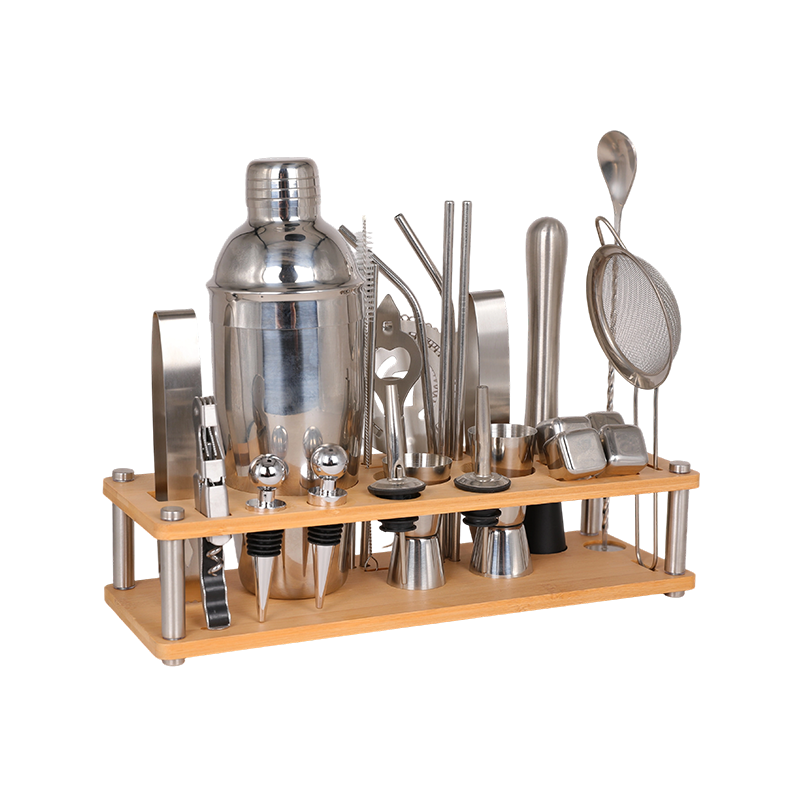
Understanding the Role of Custom Barware Kits in Modern Bars
Bars today vary widely in operational style—from high-volume venues requiring quick turnover to smaller craft bars focusing on technique and presentation. A Custom Barware Kit allows these businesses to match tools with their service model. When tools follow a unified design language, bartenders move more predictably, reducing hesitation when switching from shaking to stirring or from measuring to straining.
The value of customization extends beyond decoration. Handle textures influence grip security, weight distribution affects pouring precision, and measurement markings guide consistent recipes. When kits are tailored to a bar’s workflow, teams can standardize training and shorten onboarding time. For example, a bar emphasizing citrus-forward drinks may choose reinforced strainers and ergonomic juicers in its kit, while a whiskey-focused venue may prioritize heavier spoons and weighted shakers. Customization becomes a strategic decision rather than a visual preference.
For home users, tailored kits create a learning environment where tools act as intuitive guides. A thoughtfully arranged set encourages experimentation without overwhelming beginners with unnecessary accessories.
How Stainless Steel Cocktail Shaker Manufacturers Define Structural Quality
Manufacturers specializing in stainless steel cocktail shakers operate within a broad spectrum of technical requirements. Material selection, welding technique, thickness control, and surface treatment directly influence how a shaker performs during service.
Stainless steel grades such as 304 and 201 differ in corrosion resistance, density, and temperature conductivity. Bars dealing with fast-paced environments often choose shakers with thicker sidewalls, which reduce dents and offer a more stable shaking sensation. Meanwhile, professional training centers may prefer medium-weight designs that help students build consistent muscle memory.
Manufacturing also involves structural compatibility between components. A tightly fitted two-piece shaker ensures security during vigorous shaking, but if fitted too tightly, it may slow down transitions between drinks. Similarly, a three-piece shaker allows precision but requires balanced threading to avoid leakage. Achieving this balance requires controlled machining and calibration at the production level.
Surface finishing contributes to hygiene management and appearance. Brushed stainless steel hides minor surface marks, while mirror finishes appeal to bars emphasizing presentation. Some bars choose matte coatings for a contemporary style, though these may require careful maintenance to avoid uneven wear. Each finish brings both benefits and responsibilities, and manufacturers advise buyers to select based on actual service conditions.
The Practical Value of a Professional Cocktail Kit in China
China’s mixology industry has expanded rapidly, supported by rising consumer interest in cocktails, educational institutions, and cross-cultural exchange. A Professional Cocktail Kit in China reflects this growth. Manufacturers design these kits with practical functionality in mind—balancing durability with comfort, and versatility with clear measurement guidance.
Training programs across major cities rely on standardized kits to teach foundational techniques. When tools are consistent, instructors can focus on refining hand movements rather than addressing variations caused by mismatched equipment. Many educational facilities choose kits produced in China because production lines allow stable quality across large quantities.
Bars with international influences also rely on these kits to maintain recipe consistency across different staff members. A kit with accurate jigger markings, balanced spoons, and well-calibrated shakers helps bartenders execute drinks with predictable flavor profiles. For bartenders who work long shifts, ergonomic shaping reduces fatigue. Small details—like spoon handle curvature or the angle at which shaker cups merge—play a measurable role in daily comfort.
How Customization Strengthens Bar Identity and Workflow
A Custom Barware Kit often becomes part of a bar’s brand identity. Engraved logos, color-tailored coatings, and themed designs reinforce the atmosphere that the bar wishes to present. More importantly, customized functional details reinforce operational consistency.
Bars adopting signature drink programs may request modified strainers, aeration-focused shaker designs, or custom jigger measurements. Custom kits can also reflect cultural or regional influences—such as Asian-themed bars selecting bamboo-accented tools or tropical venues choosing corrosion-resistant finishes suitable for outdoor humidity.
Manufacturers work closely with bar consultants to ensure modifications remain practical. A tool may look appealing, but if its weight distribution affects pouring speed or stability, it requires adjustment. Effective customization blends aesthetic goals with technical feasibility.
Manufacturing Considerations Behind Stainless Steel Barware
Behind every stainless steel tool lies a series of engineering steps that determine durability and performance. These include:
Material sourcing: Selecting steel with consistent composition ensures predictable reactions to temperature and pressure.
Deep-drawing and welding: Shakers rely on seamless drawing or carefully executed welding to maintain structural integrity.
Alignment testing: Ensuring that lids and strainers align properly prevents leakage and improves workflow.
Surface treatment: Polishing, brushing, or coating requires controlled processes to avoid uneven results.
Manufacturers also consider environmental safety. Coatings must meet international compliance requirements, including food-contact regulations. Clients purchasing for large chains often request certifications verifying material safety and production traceability.
How Professional Kits Support Training, Consistency, and Expansion
Growing bars, training centers, and mobile events frequently choose a Professional Cocktail Kit in China because the domestic industry has developed infrastructure capable of handling large orders without losing consistency.
Training centers benefit from:
- Predictable tool weight
- Accurate measurement lines
- Uniform shaker sealing
Sturdy strainers suitable for repeated daily use
For expanding bar groups, acquiring large sets from a consistent supplier ensures new locations maintain the same operational feel. This subtle uniformity supports consistent guest experience across branches.
Home users also benefit from professional kits. Many individuals exploring cocktail preparation want durable tools that teach correct technique. Kits designed for professionals often include balanced weights and intuitive measurement cues, making them helpful for early learning.
Working With Bartending Tools Suppliers for Large-Scale Needs
Bartending tools suppliers play an essential role in bridging communication between manufacturers and global buyers. They help clients determine which materials, finishes, and tool combinations align with their needs. For example, a small independent bar may prioritize aesthetic cohesion, while a hotel group may focus on durability under extensive use.
Suppliers also manage packaging design, labeling, and shipping coordination. Kit assembly must account for transportation conditions—shakers should be wrapped individually to avoid scratches, and accessories like peelers or zesters require protective covers.
Bars seeking private-label tools can request modifications through suppliers, ranging from subtle logo engraving to fully customized tool shapes. These services help brands enhance their professional image and strengthen customer recognition.
Choosing Between Custom and Standard Kits for Long-Term Use
Businesses often face the decision of whether to choose a Custom Barware Kit or a standard professional kit. The choice depends on factors such as:
- Expected volume of use
- Brand identity priorities
- Budget planning
- Training needs
- Environmental conditions
- Drink menu structure
Custom kits work well for bars with strong thematic identity or unique workflow requirements. Standard kits remain practical for training centers, cafés, hotels, and distributors seeking predictable performance across large quantities.
Buyers are encouraged to evaluate samples before finalizing decisions. Hands-on testing reveals subtle comfort differences that specifications alone may not show.
Industry Growth Supported by Wuyi Jinnuo Industrial & Trading Co., Ltd.
As bars and consumers explore cocktail culture more deeply, companies like Wuyi Jinnuo Industrial & Trading Co., Ltd. play an increasing role in global supply. With roots in a region known for hardware craftsmanship, the company combines manufacturing strength with an understanding of beverage culture. Its engineering experience supports the production of stainless steel shakers, customized mixology kits, and professional-grade tools used across bars, restaurants, hotels, and educational institutions.
